Engineered for this patient. Not the average of all patients.
Standard implants are designed for a population. Patient-specific implants are designed for one person — derived directly from their anatomy, engineered to fit without compromise, and manufactured to the precise specifications that the surgery demands.
Atomic Additive produces custom implants from patient CT and MRI data, working in close collaboration with the surgical team from design through to delivery. Every implant begins with segmentation of the patient's anatomy. The design is developed iteratively — reviewed, refined, and approved by the operating surgeon before a single component is manufactured.
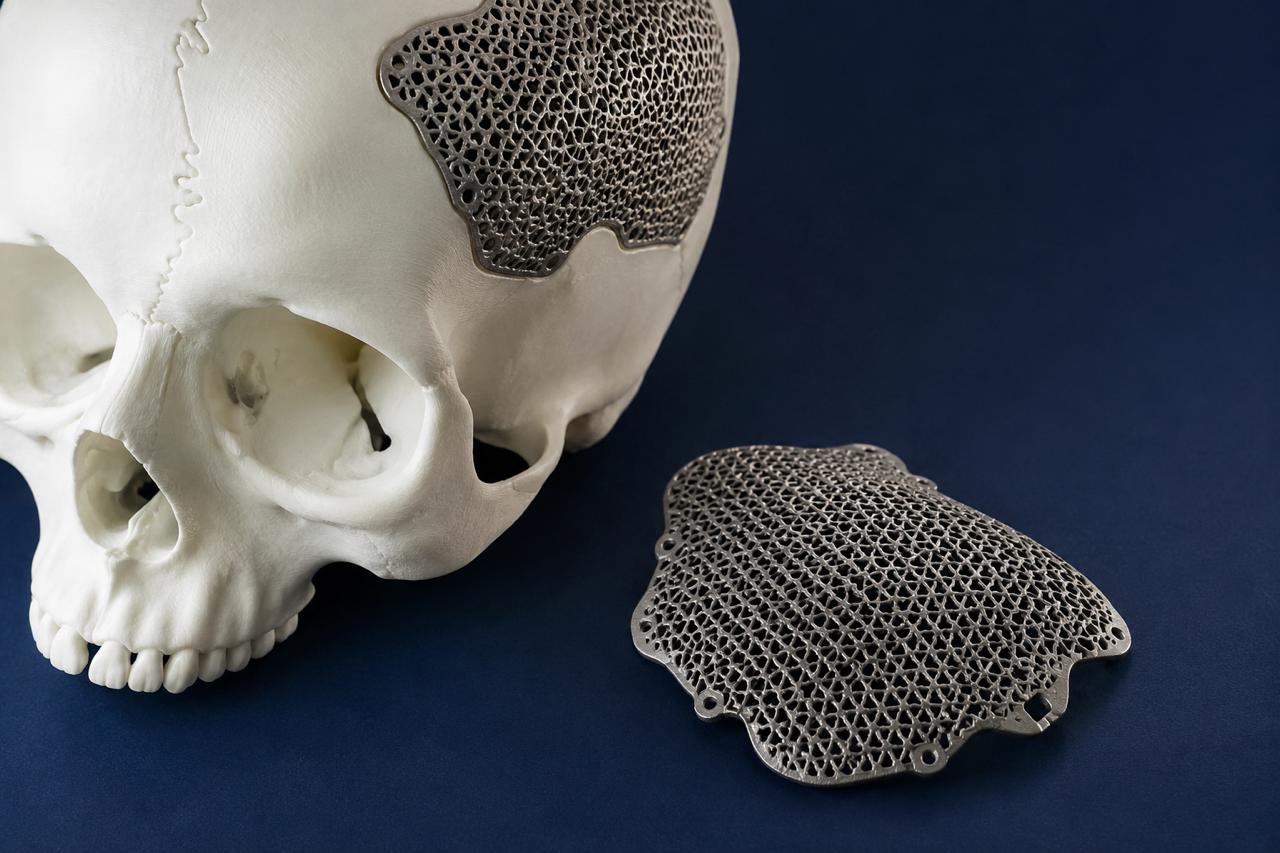
We engineer patient-specific implants across six broad categories — each derived from the individual's own imaging data.
Cranioplasty, skull base reconstruction, post-tumour defect repair, and burr hole covers — each engineered to the precise geometry of the patient's cranial defect.
Cervical fusion devices, vertebral body replacements, and interbody cages — designed to match endplate anatomy and optimise load transfer across the specific spinal segment.
Revision arthroplasty, complex fracture reconstruction, joint reconstruction, deformity correction, and pelvic implants — for cases where standard catalogues cannot accommodate the anatomy.
Mandibular reconstruction plates, orbital wall implants, zygomatic and midface plates, and TMJ prostheses — millimetre-accurate and designed for the specific craniofacial defect.
Post-resection bony defect reconstruction across the head, neck, and extremity — engineered around the specific defect geometry following oncological resection.
Custom prosthetic systems for limb-preserving surgery — designed to maximise function and structural durability following oncological or traumatic bone loss.
Three proven materials — each selected for specific anatomical, functional, and clinical monitoring requirements.
Ti-6Al-4V ELI
High strength, excellent osseointegration, and long-term biocompatibility. The preferred material for load-bearing cranial, spinal, and orthopaedic implants. Manufactured using DMLS for precision lattice structures that promote bone ingrowth.
Polyether Ether Ketone
Radiolucent and biomechanically compatible with cortical bone — eliminating stress shielding and allowing unobstructed imaging follow-up. Preferred where post-operative CT or MRI monitoring is clinically critical.
Polymethyl Methacrylate
Widely used in cranioplasty and bone cement applications. Excellent mouldability, long-term biocompatibility, and proven clinical track record in cranial reconstruction. Cost-effective for appropriate anatomical sites.
| Output | Detail | Turnaround |
|---|---|---|
| 3D Anatomical Segmentation | Full patient anatomy reconstructed from CT or MRI DICOM as the foundation for implant design | 3–5 working days |
| Implant Design Proposal | Initial digital design shared with the operating surgeon for review and feedback | 5–7 working days |
| Surgeon Review & Sign-Off | Iterative review cycle — all modifications incorporated before design is locked | Per surgeon schedule |
| Manufactured Implant | Produced in titanium (DMLS), PEEK, or PMMA as clinically specified — with full QC documentation | 7–14 working days post sign-off |
| Sterile-Ready Delivery | Complete traceability documentation included. Clinical team available through to and beyond the procedure. | Included with implant |
| Urgent Cases | Priority processing for time-sensitive surgical cases — contact us directly to discuss timeline | Contact us |
CT or MRI DICOM files submitted by the surgical team. No additional imaging required — we work from your institution's existing scans.
Patient anatomy segmented and reconstructed in 3D. The defect geometry is precisely mapped as the foundation for implant design.
Initial implant design produced and shared digitally with the operating surgeon for review. Every design decision is documented and justified.
The surgeon reviews the design, requests any modifications, and provides formal sign-off. Nothing proceeds to manufacture without this approval.
Production in the specified biocompatible material under controlled, documented conditions. DMLS titanium or machined PEEK/PMMA as appropriate.
Every implant measured and verified against the approved design specification. Dimensional accuracy confirmed before dispatch.
Delivered sterile-ready with complete traceability documentation. Our clinical team remains available through the procedure and beyond.
Converting patient CT and MRI scans into precise 3D anatomical reconstructions — the clinical foundation for every case.
Learn more →Precision cutting, drilling, and positioning guides that translate the preoperative plan to the surgical field accurately.
Learn more →High-fidelity physical replicas for surgical rehearsal, MDT briefings, and patient consent at true scale.
Learn more →Submit your case and our clinical team will be in touch within 24 hours to discuss your specific anatomy, material requirements, and timeline.